
Segments
Named lists of leads, defined by a query rather than maintained by hand. The audience unit workflows, campaigns and routing all target.
A segment is a named list of leads you can run a
workflow on. A dynamic segment holds a definition
rather than a list, so Meeting status is Meeting booked picks up every new
booking on its own. A static segment is a fixed set.
What You Can Filter On
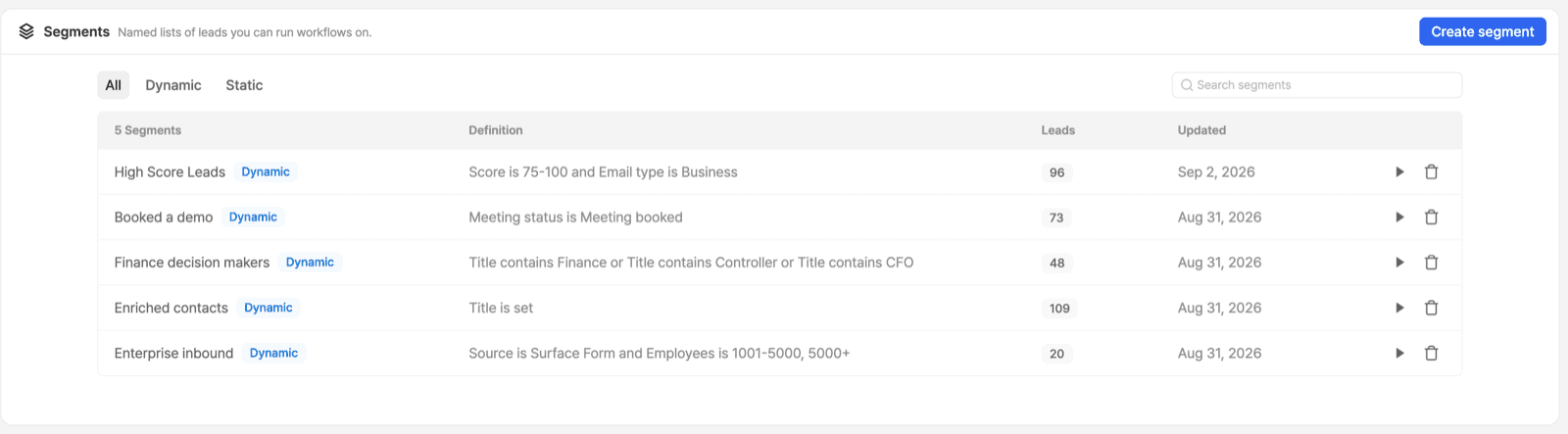
Those five definitions use six different axes:
| Axis | As it reads in a definition |
|---|---|
| Score | Score is 75-100 |
| Email type | Email type is Business |
| Title | Title contains Finance or Title contains Controller or Title contains CFO, or Title is set |
| Source | Source is Surface Form |
| Company size | Employees is 1001-5000, 5000+ |
| Meeting status | Meeting status is Meeting booked |
That is what five real segments happen to use, not the full list of fields. Open Create segment in the app to see everything your workspace can filter on before you plan around a dimension.
What Segments Are For
| Use | How |
|---|---|
| Running workflows | Run a workflow over a named list of leads. |
| Campaign audiences | A campaign is planned for a buyer segment and an outcome, so "who this is for" is a definition rather than an exported CSV. |
| Routing | Segment is one of the things Surface can route on, alongside territory and existing ownership. → Routing |
| Reporting | "Enterprise inbound this month" is a segment plus a date range. |
Designing Segments That Stay Useful
One decision per segment. high-intent-no-meeting is actionable;
all-leads-2026 is just a date filter.
Let the score carry intent. Score is 75-100 is usually a better filter
than a stack of firmographics, because behaviour is already weighed inside the
score. See Scoring.
Decide what makes someone leave. Meeting status is Meeting booked is meant
to fill up as people book. A follow-up audience with no exit condition turns
into everybody.
Name them for the action. enterprise-inbound beats Segment 3 (final).
A Starting Set
Nothing in the product ships these. They are the shapes teams tend to land on, written in the axes above:
| Segment | Definition | Used for |
|---|---|---|
| High score leads | Score is 75-100 and Email type is Business | Routing and alerting |
| Booked a demo | Meeting status is Meeting booked | Excluding people who are already on a calendar |
| Decision makers | Title contains your buying titles | Campaign audiences |
| Enterprise inbound | Source is Surface Form and Employees is 1001-5000, 5000+ | ABM plays |
| Enriched contacts | Title is set | Checking how much enrichment actually resolved |
To answer "does ChatGPT traffic convert?", the tool is
get_user_journey_analytics, which breaks a form's traffic down by source,
medium, campaign, AI referrers and click IDs. See the
tool reference.